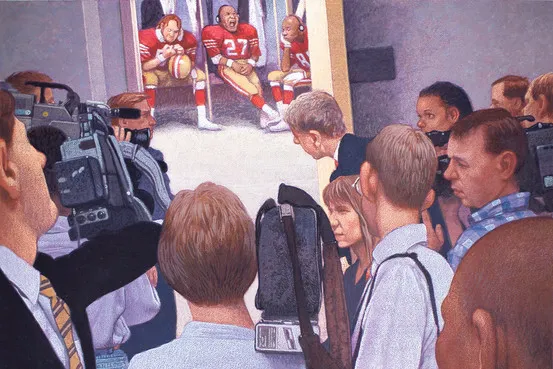
Words That Stuck: The Hard-Earned Wisdom Chuck Muncie Passed Down in the Locker Room
Photo: Erik Drost, CC BY 2.0, via Wikimedia Commons
There's a version of Chuck Muncie that most casual football fans know — the powerful, slashing runner who could turn a busted play into a thirty-yard gain, the guy who made NFL defenses look slow and confused. That version is real and worth celebrating every single day here at Chuck Muncie Forever.
But there's another version that doesn't show up in box scores or highlight packages. It lives in the memories of younger players who found themselves sitting next to him in a film room, riding next to him on a charter flight, or catching a quiet moment with him after practice. That version of Chuck Muncie was a teacher — unassuming, direct, and deeply invested in the people around him.
The Kind of Leader Who Didn't Need a Title
Not every locker room philosopher announces himself. Some guys wear the captain's patch and give the pregame speeches. Others just... show up. They show up early, they stay late, and somewhere in between they say something that a twenty-two-year-old kid from a small college town carries with him for the rest of his life.
Chuck Muncie was firmly in that second category. People who played alongside him — especially younger backs trying to find their footing at the professional level — consistently describe a man who led by example first and by conversation second. He wasn't trying to be anyone's life coach. He was just honest, and in a league full of ego and posturing, honesty has a way of cutting through.
Former offensive linemen who blocked for him in San Diego have talked about how Muncie would pull younger players aside after film sessions, not to criticize, but to explain. He'd point out what he saw from his angle on the field, translate the complexity of a defensive scheme into plain language, and then ask the player what they saw. It was collaborative. It respected the intelligence of the person he was talking to.
"Don't Play Scared"
One phrase that comes up again and again when former teammates reflect on Muncie's mentorship is deceptively simple: don't play scared.
On the surface, it sounds like standard motivational talk — the kind of thing you'd see stitched on a locker room banner. But the way Muncie apparently delivered it gave the words real weight. He wasn't talking about physical fear. He was talking about the mental hesitation that creeps in when a young player starts worrying about mistakes instead of making plays. The half-second of doubt that turns a good runner into a predictable one.
Muncie understood this from his own experience. Breaking into the NFL in the mid-1970s, playing in an era when running backs were expected to be durable workhorses rather than featured weapons, he had to fight through his own internal noise to become the player he knew he could be. That hard-won self-knowledge made his advice credible in a way that no coaching manual could replicate.
Younger players noticed. When a guy who'd been doing it at the highest level for years tells you to trust your instincts and stop second-guessing yourself, it lands differently than when it comes from a coach in a polo shirt who never took a hit in his life.
The Film Room as Classroom
If the practice field was where Muncie demonstrated his craft, the film room was where he explained it. Multiple accounts from former teammates suggest that he was unusually engaged during film sessions — not passive, not just logging time, but actively processing what he saw and willing to share those observations with whoever was sitting nearby.
For younger running backs especially, this was invaluable. Reading a defense before the snap is one of the hardest skills to develop at the professional level, and it's not something that can be fully taught in a classroom setting. It requires pattern recognition built through repetition and guided attention. Muncie, almost instinctively, understood how to point a younger player's eyes toward what mattered.
He'd pause on a particular frame and ask a question rather than give an answer. "What's the linebacker doing with his feet right there?" or "Where's the safety cheating before the snap?" He was building a way of seeing, not just transferring information. That's a sophisticated pedagogical approach, even if Muncie himself probably wouldn't have described it in those terms.
Advice That Went Beyond Football
Some of the guidance Muncie offered wasn't about football at all — and those might be the moments his former teammates remember most vividly.
The NFL can be a disorienting place for young men who've been treated like celebrities since high school. The money, the attention, the sudden distance from the communities and families that shaped them — it creates a specific kind of vulnerability that the league has never been particularly good at addressing. Muncie, who navigated his own complicated journey through professional football, seemed to understand that vulnerability.
He talked to younger players about staying grounded. About not letting the league define the totality of who they were. About maintaining relationships outside of football that had nothing to do with what they could do on a field. For players who were just starting to figure out who they were as adults, hearing that from a veteran they respected carried real meaning.
It wasn't preachy. By all accounts, Muncie wasn't the type to lecture. He'd offer a thought, maybe share something from his own experience, and then let the other person sit with it. That restraint — knowing when to speak and when to let silence do the work — is itself a form of wisdom.
The Legacy That Doesn't Retire
Chuck Muncie's career statistics tell one story. His Pro Bowl selections, his rushing totals, his role in some of the most exciting offenses of his era — all of that is documented, debated, and celebrated here regularly.
But the mentorship legacy is harder to quantify and, in some ways, more enduring. The players he influenced went on to have their own careers, some of them long and successful. A few became coaches themselves, passing along frameworks and perspectives that, at some point in the chain, trace back to a conversation in a locker room or a film session in San Diego or New Orleans.
That's how real influence works. It multiplies. It shows up in unexpected places years later. It lives in the instincts of a running back who learned to read a defense a certain way, or in the calm of a veteran who remembers being told, simply and directly, not to play scared.
Chuck Muncie was a football player. He was also, quietly and without fanfare, a teacher. And here at Chuck Muncie Forever, that part of his story deserves just as much recognition as anything he ever did between the hash marks.