From the Film Room to the Field: How Chuck Muncie's Footwork Still Trains Today's NFL Running Backs
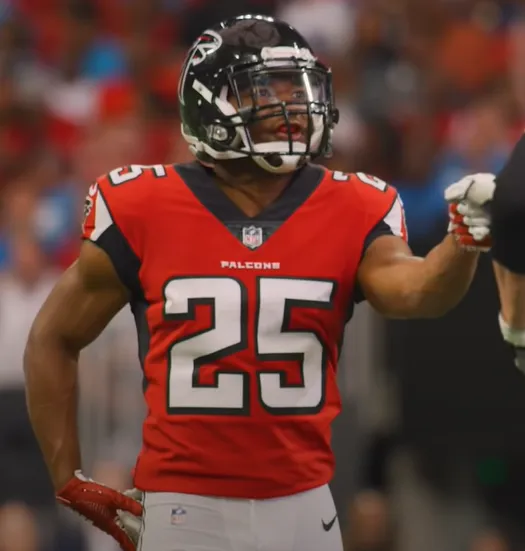
Photo: Atlanta Falcons, CC BY-SA 3.0, via Wikimedia Commons
There's something almost poetic about the idea of a coach freezing a grainy 1980s game reel, rewinding it three times, and then turning to a 22-year-old rookie and saying, "Watch his feet. Right there. That's what I need from you." But that's exactly what's happening in NFL training facilities today — and the man on that tape is Chuck Muncie.
For fans who followed Muncie through his years with the Saints and the Chargers, none of this is surprising. The guy was operating on a different level. But for a generation of coaches who never saw him play live, discovering his film has been something close to a revelation.
What Made Muncie's Style So Different
Let's start with the basics, because context matters here. When Muncie came into the league in 1976, the dominant philosophy around running backs was pretty straightforward: find the hole, hit the hole, get what you can. Power was the currency. Finesse was considered something you left on the college field.
Muncie didn't buy into that. At 6'3" and around 227 pounds, he had the frame of a fullback but moved like a guy half his size. His footwork in the backfield — the way he'd stutter-step to freeze a linebacker, or plant and redirect without losing a step — was genuinely unusual for a man his size at that time. He wasn't dancing around defenders. He was reading them, processing information in real time and making micro-adjustments that most of his contemporaries simply weren't doing.
His route-running out of the backfield was equally ahead of its time. Muncie ran clean, precise patterns with the kind of separation technique you'd expect from a wide receiver. That combination — size, vision, and receiving ability — didn't really have a template in the NFL yet. Chuck Muncie was the template.
Coaches Start Paying Attention
Fast-forward to the modern game, where the running back position has evolved into something far more multidimensional than it was in the 1970s. Today's elite backs — the ones getting the big contracts and the highlight packages — are expected to be threats out of the backfield as receivers, to make defenders miss in space, and to process defensive alignments before the snap. Sound familiar?
Coaches who specialize in running back development have increasingly turned to historical film to find models for what they're teaching. And Muncie's tape keeps coming up.
One strength and conditioning coach working with an NFC team (who asked to remain anonymous because he wasn't authorized to speak publicly) described it this way: "When I'm working with a young back on balance and contact absorption, I'll pull up Muncie. The way he kept his pad level while still being able to see the field — it's textbook. Except nobody wrote the textbook yet when he was doing it."
That idea — that Muncie was essentially writing rules the league hadn't formalized yet — comes up a lot when you talk to people who've studied his film closely.
The Balance Equation
One of the most-cited aspects of Muncie's game among contemporary coaches is his center of gravity. Watch him take a handoff and you'll notice he never fully commits to a direction until he absolutely has to. His weight stays centered, his shoulders stay square, and his eyes stay downfield. It looks almost effortless on tape, but anyone who's tried to coach that skill knows how rare it is.
Modern sports science has given us language for what Muncie was doing intuitively. Concepts like "reactive strength" and "deceleration mechanics" are now standard vocabulary in NFL strength programs. What Muncie demonstrated on game film aligns almost perfectly with what biomechanists now identify as optimal movement patterns for running backs in space.
An offensive analyst who spent time breaking down historical backfield film for a consulting project put it bluntly: "Muncie's body control under pressure is as good as anything I've seen from any era. If you put him in today's league with today's training methods behind him, the conversation around all-time great backs looks different."
Route Running as a Teaching Tool
The receiving dimension of Muncie's game deserves its own conversation. His 1981 season with San Diego — where he combined for over 1,600 yards from scrimmage — is the obvious reference point, but the mechanics behind those receiving numbers are what coaches are zeroing in on.
Muncie ran routes with intentionality. His stem (the initial path of a route before the break) was consistent enough to set up defenders but not so mechanical that it telegraphed his intentions. He sold routes the way wide receivers are coached to do, using his body angle and speed variation to create separation. For a running back in the early 1980s, that level of route craft was genuinely uncommon.
Coaches working with backs who need to develop as receivers will sometimes use Muncie's film as a counter-example to the "just get open" mentality that plagues younger players. "There's a difference between getting open and creating openings," one position coach explained. "Muncie understood the second thing. That's what we're trying to teach."
The Legacy in Real Time
Here at Chuck Muncie Forever, we've always believed that Chuck's impact didn't stop when his career did. The numbers were great. The highlight plays were memorable. But the real legacy is something more durable — it's the way his approach to the game became embedded in how the position is understood and developed.
Every time a coach pulls up that old Saints or Chargers tape and points to Muncie's feet, his pad level, his route stem — Chuck is in that room. He's contributing to players he never met, in cities he never played in, for teams that didn't exist when he was carrying the ball.
That's not a small thing. That's what it looks like when a player's influence genuinely outlasts the era he played in.
The thread connecting Chuck Muncie's 1970s and '80s film sessions to today's NFL training rooms isn't broken. If anything, it's getting stronger as coaches dig deeper into the history of the position and keep finding the same name on the tape.
Some guys were ahead of their time. Chuck Muncie was ahead of several generations — and the game is still catching up.